
Restoring Fiduciary Value
Through Collaboration & Intelligence.
For self-insured employers, healthcare is one of the largest controllable costs — and one of the least understood. Performance Health Collaborative pairs deep analytics with vetted clinical solutions to recover margin at the source, under a single contract.
- A collaborative, not a vendor
- Solutions financially guaranteed
- One layer for employers & clinicians

Turn claims data into a clear view of cost, risk, and provider performance.
Match the highest-cost drivers to vetted clinical solutions and root-cause interventions.
Join a regional purchasing alliance to buy healthcare based on value, not opacity.
Track outcomes in a Fiduciary Dashboard with radical transparency as claims adjudicate.
One collaborative. Every capability connected.
Why We Exist
US healthcare has been catastrophic for mainstream Americans. Despite paying double what people in other developed nations pay, the US delivers mediocre-to-poor outcomes — at costs that threaten families, employers, and the national economy alike.
The system rewards profit over health.
Virtually all healthcare firms — whatever their legal status — prioritize profitability above patient health outcomes. Success too often demands unnecessary care, excessive pricing, and relentless margin, and predatory practices abound throughout the system.
Much of the worst excess occurs not at the frontlines of care, but among middlemen — insurers, drug distributors, and PBMs positioned between patients and their care. And exorbitant spending has not bought better health: on key measures such as life expectancy, infant mortality, chronic disease management, and heart-attack mortality, US outcomes are consistently last or nearly last among developed nations.
Nearly 45% of all US healthcare spending now flows to just nine intermediary firms — up from 25% a decade before. That is money that never touches patient care.
Measurably better outcomes. Consistently lower costs.
Performance Health Collaborative will facilitate the identification and delivery of consistently, measurably better health outcomes and lower costs than is typically available to patients and healthcare purchasers around the US.
Seek, vet, and bundle proven high performers.
PHCC seeks and vets proven high performers in the healthcare marketplace, bundling their services so purchasers can appreciate their aggregated impacts. We encourage purchasers to work collaboratively — hiring proven high-performing vendors rather than conventional providers — and develop financial incentives that reward purchasing value- and performance-based arrangements.
Margins Are Compressing
Input costs are rising faster than the prices most companies can charge. The squeeze is structural — and healthcare is the largest piece of it that goes unmanaged.
You can’t control PPI. You can control what you pay for healthcare.
Producer prices are accelerating. ITR Economics raised its 2026 PPI forecast to 5.0%, and actual 12-month PPI through April 2026 reached 6.0% — the largest reading since December 2022. Meanwhile, most companies hold pricing power of only 2–3% a year.
When input costs climb 5–6% annually and prices rise 2–3%, the gap comes straight out of margin. A company earning a 10% operating margin can see it cut roughly in half within three years if the trend goes unmanaged.
The squeeze is the gap — medical trend rises two-to-three times faster than the prices companies can recover, and the distance between those bars comes straight out of margin. Most employers have near-zero data on where that healthcare spend goes.
A Different Way to Buy Healthcare
Most employers buy healthcare blind, then absorb whatever the claims deliver. Performance Health Collaborative replaces that with data, vetted solutions, and collective strength — a collaborative, not a vendor, working with employers, clinicians, and patients alike.
A Data Analytics Platform
Send your claims data and, within days, get a clear picture: where your population is healthy, where you’re hemorrhaging, and how your providers actually perform — one transparent source of truth, benchmarked against population norms.
Built-In Solutions, Not Just Data
Analytics tell you about problems; they don’t fix them. PHCC pairs the data with vetted clinical solutions — led by Optimal Medical Therapy, cardiometabolic care and musculoskeletal programmes — matched to the greatest areas of spend and the discrete needs of each employer.
Collective Purchasing Strength
Employers on the platform form a regional purchasing alliance — buying healthcare based on value rather than negotiating alone against a fragmented, opaque market.
Measurable Results
Outcomes update in the Fiduciary Dashboard as claims adjudicate — radical transparency with no “secret sauce.” You see the problem, the intervention, and the result, side by side.
Every solution carries its own scorecard — clinical, financial, engagement and operational — computed from your claims rather than the vendor’s own report. That is what makes a renewal decision defensible.
Treat the Root Cause, Not the Crisis
Chronic conditions like Type 2 diabetes and cardiovascular disease share a common metabolic root cause. Optimal Medical Therapy targets that root cause — addressing the problem before it escalates into a costly, avoidable event. We import proven care designs such as Nuka and Singapore to fix problems at the source rather than profit from them.
From Population Data to Patient Action
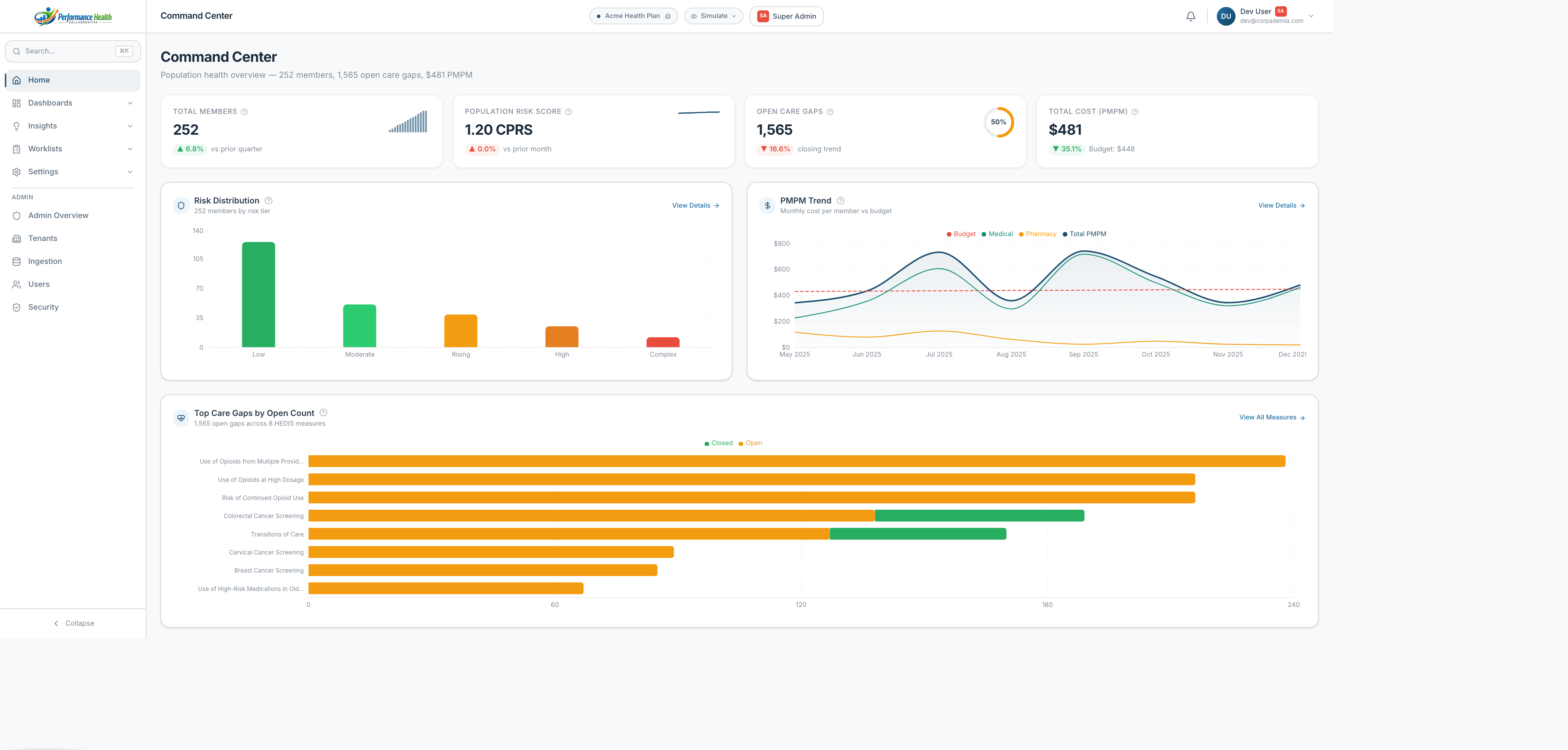
A purpose-built analytics platform that turns your claims data into a clear, real-time view of where cost and risk concentrate, and what to do about it.
A Single Source of Financial & Clinical Truth
Population, risk, and cost in one strategic view, updated as claims adjudicate — built to answer the questions a fiduciary is accountable for.
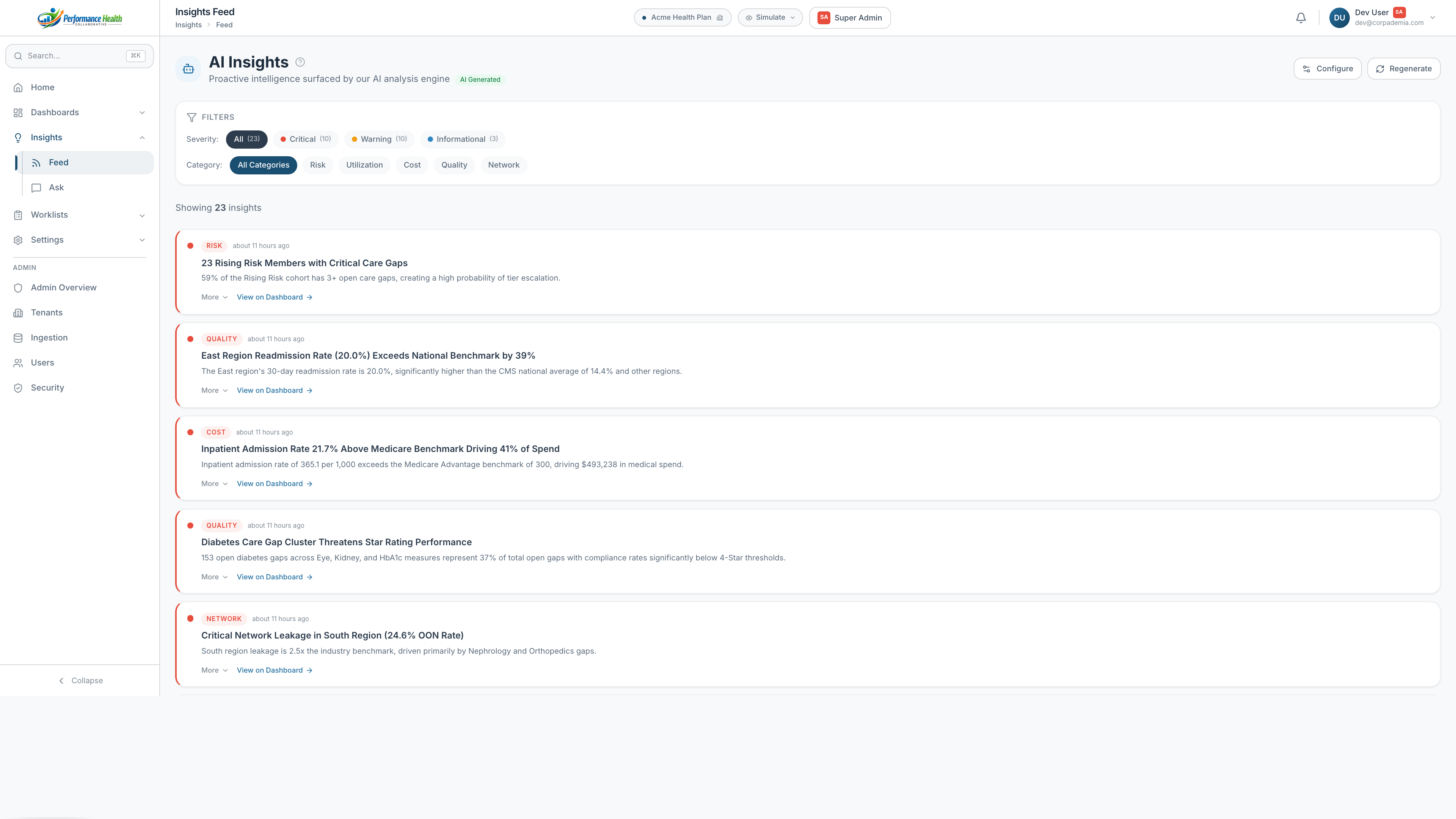
Findings That Surface Themselves — Then Answer Back
Insights are generated nightly across your whole population, ranked Critical, Warning or Info, and each one links to the members behind it. Then ask the platform anything in plain English — it answers from your warehouse, within whatever your role is allowed to see.
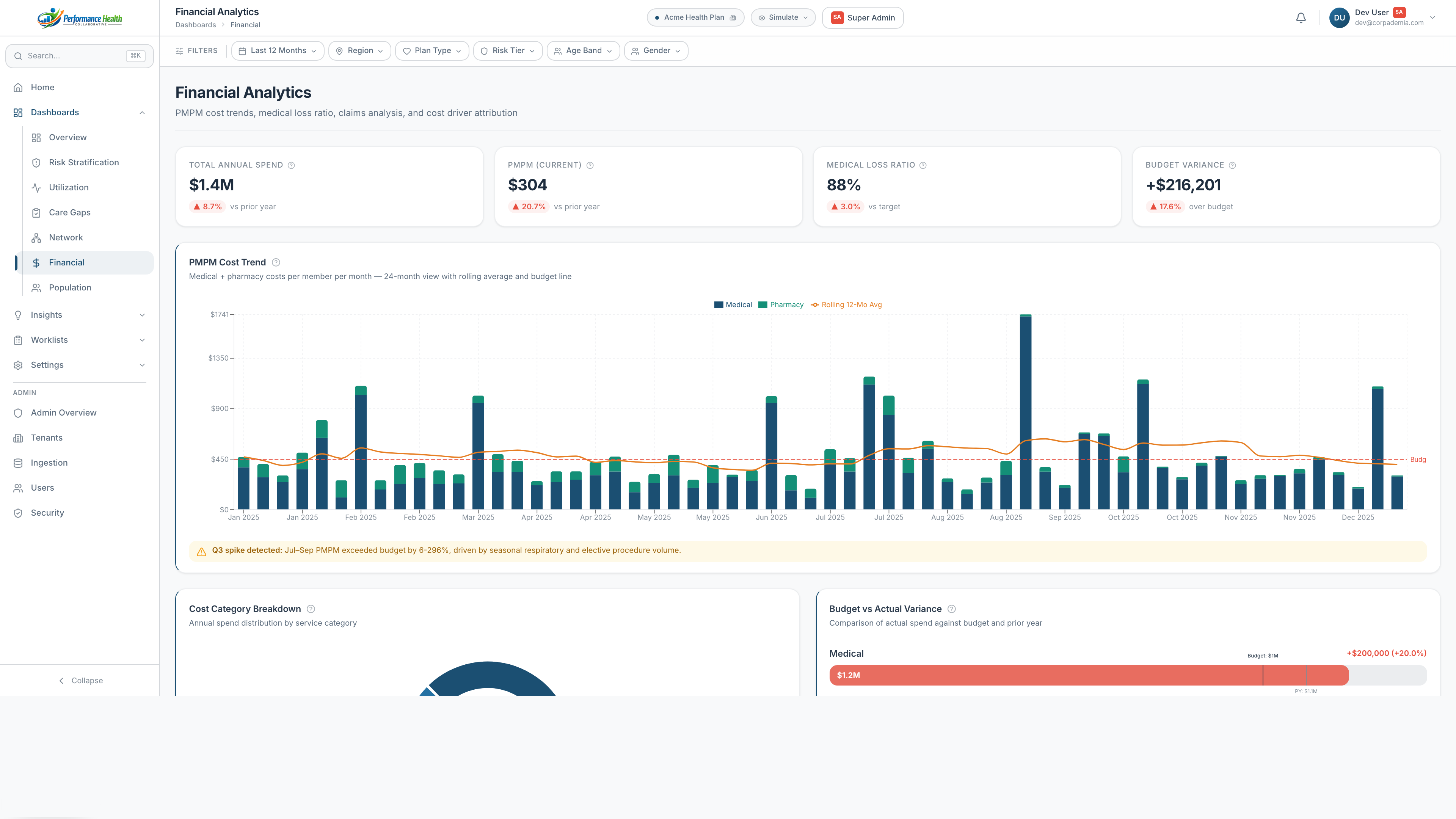
Follow Every Dollar to Its Root Cause
Cost trends, loss ratio, and cost-driver attribution in full view — transparent PMPM pricing, a fraction of legacy analytics cost, no “secret sauce.”
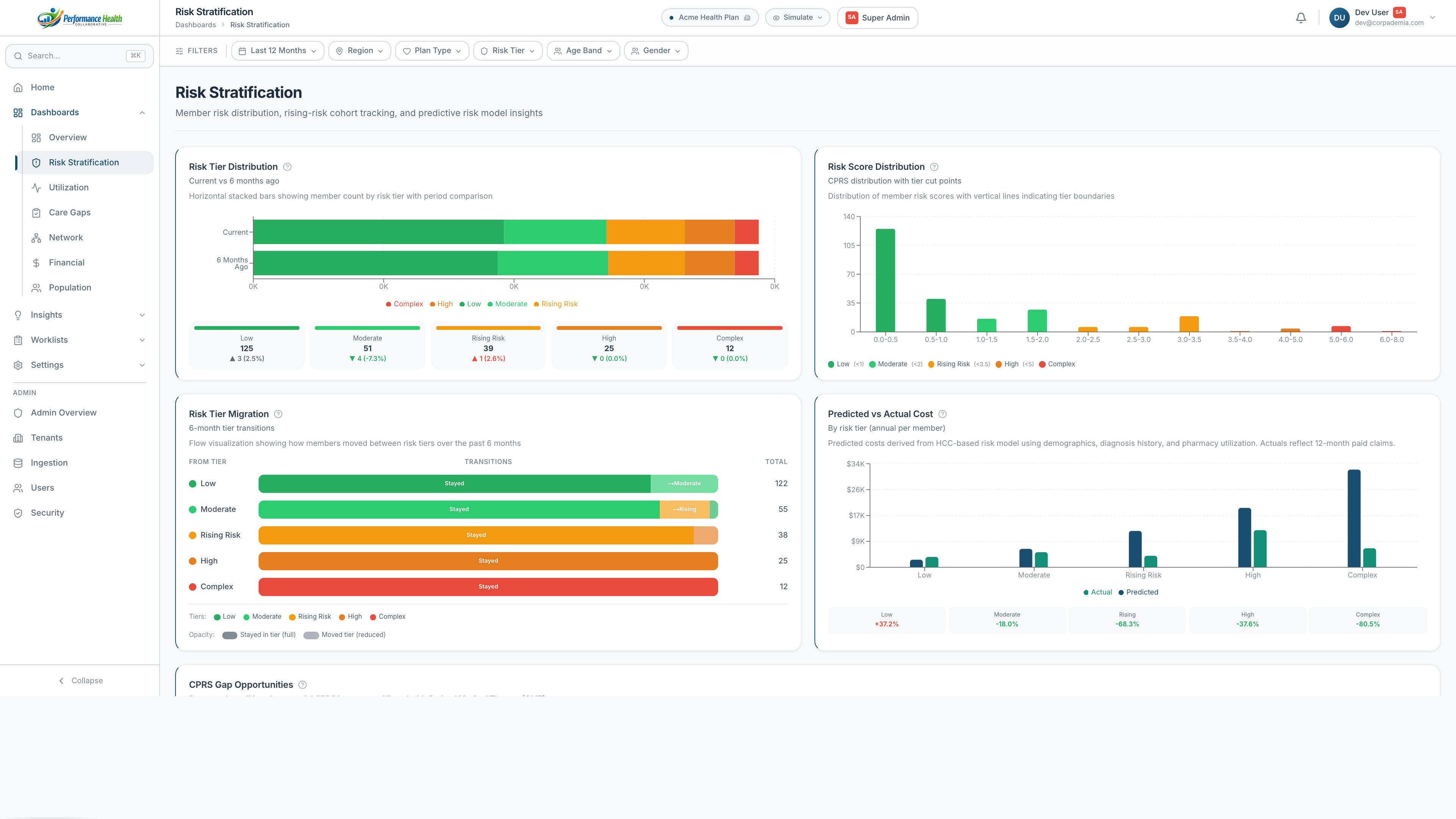
Find the Root Cause Early
Risk tiering and predictive modeling flag rising-risk members while the intervention window is still open — with automated outreach to reach them.
OMT, Scored Across Every Axis
Most quality programmes treat diabetes, hypertension, kidney disease and vascular disease as four separate registries — so a member with hypertension and dyslipidemia and no diabetes code goes unmeasured. The platform scores optimal medical therapy over one cardiometabolic population, evaluating each therapy pillar against that member’s own conditions.
Trial Access as a Benefit
For members with advanced disease, a clinical trial can be the best available care — and the sponsor, not the plan, pays for the study therapy. The platform screens your own population against indexed trials, routes the matches to a navigator, and shows what each match is worth with every assumption on screen.
Value parameters are published with their source, range and retrieval date, and versioned — a published version is never quietly changed underneath a result. Demonstration populations are labelled as synthetic.
Enterprise-grade, with each client’s data isolated in its own warehouse, multi-factor authentication required, and every access audited — live in 6 weeks, not 6–18 months, with no professional-services fees. Claims move under a Business Associate Agreement.
The People Behind the Model
The collaborative grew out of decades spent vetting high-performing care networks — and requiring vendors to financially guarantee their results before bringing them to employers. Analytics, clinical innovation, and market strategy, aligned around a single fiduciary mission.

Justin Davis, PhD
Healthcare Analytics & Systems EngineeringA specialist in healthcare analytics, revenue cycle optimization, and AI engineering. Justin builds enterprise-grade data systems and AI frameworks that don’t just identify inefficiencies—they resolve them at the source. His expertise in healthcare data architecture and platform design enables organizations to convert complex system insights into measurable gains in clinical performance, operational efficiency, and financial sustainability.
LinkedIn
Scott Leggett
Orthopedic Programs & ASC DevelopmentScott Leggett brings more than 35 years in orthopedic and physical therapy program management and 27 years in ASC management and development. Beginning in exercise physiology and research, he moved into outpatient orthopedic physical therapy before founding a small network of physician-owned ambulatory surgery centers. A respected past board member and past-president of the California Ambulatory Surgery Association (CASA), he later co-founded Global 1 — then the largest commercially insured medical bundled payment manager in California and among the largest nationally — where from 2011 to 2020 he led operations and network expansion across physicians, surgery centers, and self-insured employers.
LinkedIn
Brian Klepper, PhD
Healthcare Reform & Market StrategyA foremost authority on healthcare reform, Brian advises the Health Rosetta and formerly led the National Business Coalition on Health. He is a leading advocate for employers and purchasers, focused on driving transparency, accountability, and market-based solutions to the healthcare cost crisis. In 2023, he was honored with the Health Rosetta Lifetime Transparency Champion award.
LinkedIn
William H. Bestermann Jr., MD
Clinical Strategy & Chronic Disease TransformationSenior Clinical Advisor and architect of the ‘Unifying Hypothesis,’ Dr. Bestermann advances a clinical model centered on Optimal Medical Therapy (OMT), targeting root causes such as metabolic dysfunction. His work demonstrates how integrated clinical care models and restructured payment systems can significantly reduce hospitalizations, improve patient outcomes, and lower total cost of care.
LinkedInTogether, PHCC delivers a unified approach that integrates analytics, clinical innovation, and financial redesign to fundamentally improve healthcare performance.
See Where Your Healthcare Dollars Actually Go
Start with a conversation, not a commitment. We’ll walk you through what fiduciary-grade analytics and vetted clinical solutions could mean for your population — no data required to begin.
- A focused 30-minute working session with our team — tailored to your questions, not a canned pitch.
- No data required to start. The conversation comes first; nothing sensitive changes hands here.
- When we engage, your claims move through a secure intake under a Business Associate Agreement — never email or web forms.